Disability stigma and discrimination
Cinder & EllaDisability stigma and discrimination shape Ella’s return to ordinary life after her accident, turning scars and limited mobility into grounds for scrutiny, exclusion, and decisions made on her behalf. The novel distinguishes her physical injuries from the social barriers imposed around them: Ella’s pain and need for a cane are real, but other people’s staring, ridicule, inaccessible expectations, and talk of segregation compound those injuries. Her recovery matters, yet the story’s central pressure is not simply whether she can walk again; it is whether others will recognize her as a person with agency rather than a body to conceal or manage.
Visible Scars and the Social Gaze
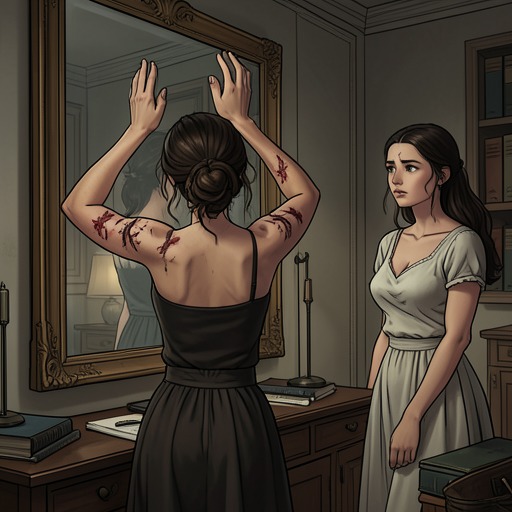
Ella has extensive raised, rough, reddened scar tissue across her right side from the shoulder downward and below her waist, though her face was spared. When she reveals more of her body, Jennifer gasps, tears up, and has to sit down before leaving the room. Ella has already learned to anticipate such reactions: on a flight from Boston to Los Angeles, even with only the scars on her right hand visible and a slight limp, other passengers stared, whispered, pointed, and recoiled. The scene establishes that stigma begins before anyone says anything openly cruel. A gaze can make her feel marked and exposed even when clothing conceals most of the evidence of injury.
Jennifer’s response later shifts from shock to attempted repair. Because she works in the modeling industry and knows about beauty and skin care, she brings Ella creams, oils, and moisturizers intended to reduce the appearance of scars. Jennifer acknowledges that they cannot erase the scars, but frames their raised and uneven areas as the features that make them conspicuous and proposes that smoothing the skin might make them less shocking; she also raises plastic surgery. Her gesture may be intended as care, but its terms presume that Ella’s body needs correction to become easier for others to look at. Anastasia’s remark that no cream can help makes the cruelty explicit, while Jennifer’s proposed solution reveals a quieter form of the same stigma: acceptance is imagined as conditional on making visible difference less visible.
That pressure affects what Ella dares to wear and disclose. She spends the summer covered from head to toe, and the school uniform’s short-sleeved shirts and knee-length skirts threaten to expose skin she has been trying to keep private. For a family costume at FantasyCon, Vivian helps provide a white cloak and long satin gloves to accompany a sleeveless, backless dress. The gloves cover Ella’s scars and let her wear the costume she loves, but the outfit also makes concealment an immediate condition of feeling able to appear in public. When Ella later meets Brian, she explains that her costume staff is also a cane, and that she has kept her scars covered because people stare, laugh, and say cruel things. Her choices about visibility are therefore not mere fashion: they are shaped by repeated social punishment.
Mobility, Access, and Exclusion
Ella’s recovery is hard-won rather than effortless. Getting out of the car and pulling herself upright with her cane takes effort, and walking without another person’s help is awkward. She is nevertheless proud: doctors had not initially thought she would regain this much movement, but she has pushed through pain and recovered much of her mobility. Her wish not to spend the rest of her life confined to a wheelchair coexists with the reality that walking remains painful and slow. The account holds improvement and continuing impairment together rather than treating recovery as an uncomplicated return to a former body.
At Beverly Hills Prep Academy, Ella tries to manage other people’s attention by wearing her winter uniform despite the heat. It does not protect her from being identified, watched, laughed at, pointed toward, or teased. Some students offer forced politeness; others make a spectacle of her. More damaging still, nobody befriends her or stands up for her. Even students who appear to pity her seem afraid to intervene, and do not invite her to sit with them at lunch. Their silence turns exclusion into a group practice: Ella is not only targeted by those who mock her but left alone by those who might have challenged them.
The school and family’s assumptions also collide with practical access needs. After her first day, Anastasia complains about parking in a disabled space and tells Ella to walk rather than sit in the back of a small convertible, insisting she will not spend a year in the rear seat. Ella explains that she cannot physically climb back there; Juliette objects to Anastasia’s treatment of her. The episode makes a concrete access problem into a test of whose comfort counts. Ella is not refusing to cooperate, as she has to clarify through tears; the car’s arrangement and Anastasia’s unwillingness to accommodate her turn her impairment into an accusation against her.
Segregation Presented as Protection
The adults’ response to Ella’s isolation at school reproduces a different kind of exclusion. Jennifer suggests finding a special school for disabled students, where Ella might be among people like herself and perhaps happier. Her father listens with interest rather than immediately challenging the proposal. Ella experiences the suggestion as a betrayal: it treats disability as evidence that she belongs elsewhere, and she expected her father to defend her against that assumption.
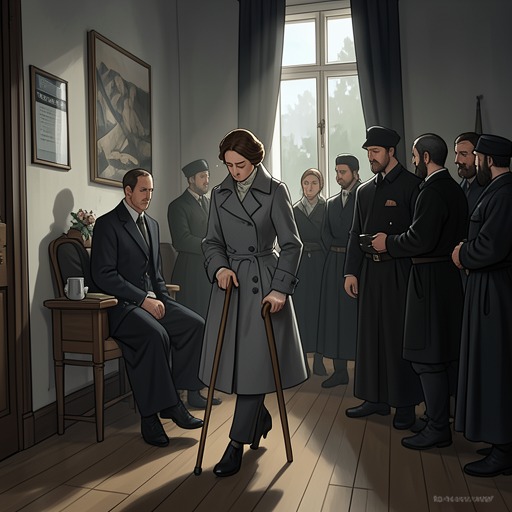
The proposal returns in a meeting involving Ella, her parents, Principal Johnson, and Dr. Parish. Johnson says a school for physically disabled people may be more suitable. Jennifer presents it as protection from bullying, a chance for Ella to adjust to her body, and a setting where she would not be the only disabled student. Those reasons describe the adults’ concern, but they also make separation sound like the solution to discrimination. Dr. Parish disagrees directly. Ella is managing physically and is intellectually well; moving her to a special school, the doctor argues, would deepen her social anxiety and feelings of inferiority, and could make it harder to return to ordinary life after graduation. A temporary respite would not resolve the exclusion she faces.
The contrast exposes two competing ideas of support. One would relocate Ella to avoid other people’s prejudice; the other recognizes that segregation risks making the prejudice seem like a natural consequence of her body. The account does not claim that every school or accommodation question has a simple answer. Instead, it gives weight to Ella’s perspective and to Dr. Parish’s distinction between attending to her needs and removing her from the settings in which she has a right to participate.
Stigma, Disclosure, and Agency
Anticipation of rejection shapes Ella’s choices even when no one is directly confronting her. She fears that Cinder would not want her if he saw her scars, and wonders whether he would be embarrassed to introduce her to his attractive friends or recoil as Jennifer has. Because she believes their friendship is all she has, she decides not to tell him that she lives in Los Angeles or suggest meeting. The decision is not a lack of desire for closeness: she longs to see his face and hear his voice. Rather, the possibility of being seen and then rejected makes disclosure feel like a risk she cannot undo.
When Ella finally tells Brian about her disability, she describes both the bodily facts and the social history attached to them. Her cane is not just part of the costume; she walks with a pronounced, painful limp, slowly, and needs it for support. She shows him the scars across her back and right side, including burns that have deformed her toes, and says she has shown them only to her doctors and Vivian. She also reveals scars on her wrists. Before this disclosure, Brian has failed to notice her cane’s practical function amid the commotion of the convention and his attention to the man who had been beside her. The scene does not make his initial oversight equivalent to the school’s sustained cruelty; it does show how easily Ella’s actual needs can disappear beneath assumptions about what others are looking at. Her account asks Brian to witness her injuries without reducing her to them.
The insults she encounters at school eventually appear in writing on her locker, including labels such as “Psycho,” “stalker,” “whore,” “loser,” “freak,” and “cripple.” Ella tries to tell herself that they are only words, that they are untrue, and that her three friends are what matter. The locker’s public display nevertheless hurts. Juliette, Vivian, and Rob react with shock and anger, and Juliette offers to call their parents so Ella can leave school for the day. Friendship provides real support here, but it does not erase the injury or make the institution’s hostile environment disappear.
Self-Determination and the Meaning of Belonging
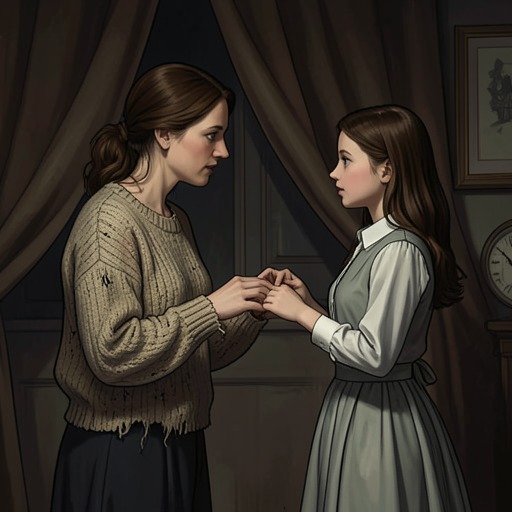
The novel’s account of disability stigma reaches beyond appearance and school placement to the question of who gets to decide what Ella needs. While discussing her future with her father and Dr. Parish, Ella asks to be released from his guardianship when she is ready to leave the clinic. She is an adult, she explains, yet someone she describes as almost a stranger makes decisions for her; even a well-intentioned family member cannot assume that what is best for his household is best for her. What she wants is people who trust her. Her request reframes care as something that should support self-determination rather than substitute for it.
This demand completes a pattern running from the disabled parking space to the proposed special school and the guardianship arrangement. In each case, disability can be used to decide where Ella should sit, study, appear, or live. The novel also refuses to make her progress depend solely on overcoming physical injury: she does regain substantial mobility through pain and persistence, but that achievement does not make mockery, inaccessible expectations, or decisions made without her consent acceptable. Stigma lies as much in the surrounding social response as in the injuries themselves. Ella’s insistence on being included, seen on her own terms, and trusted to choose is therefore not a plea to be treated as if she had no disability; it is a demand that disability not erase her personhood or authority over her life.